Goola App
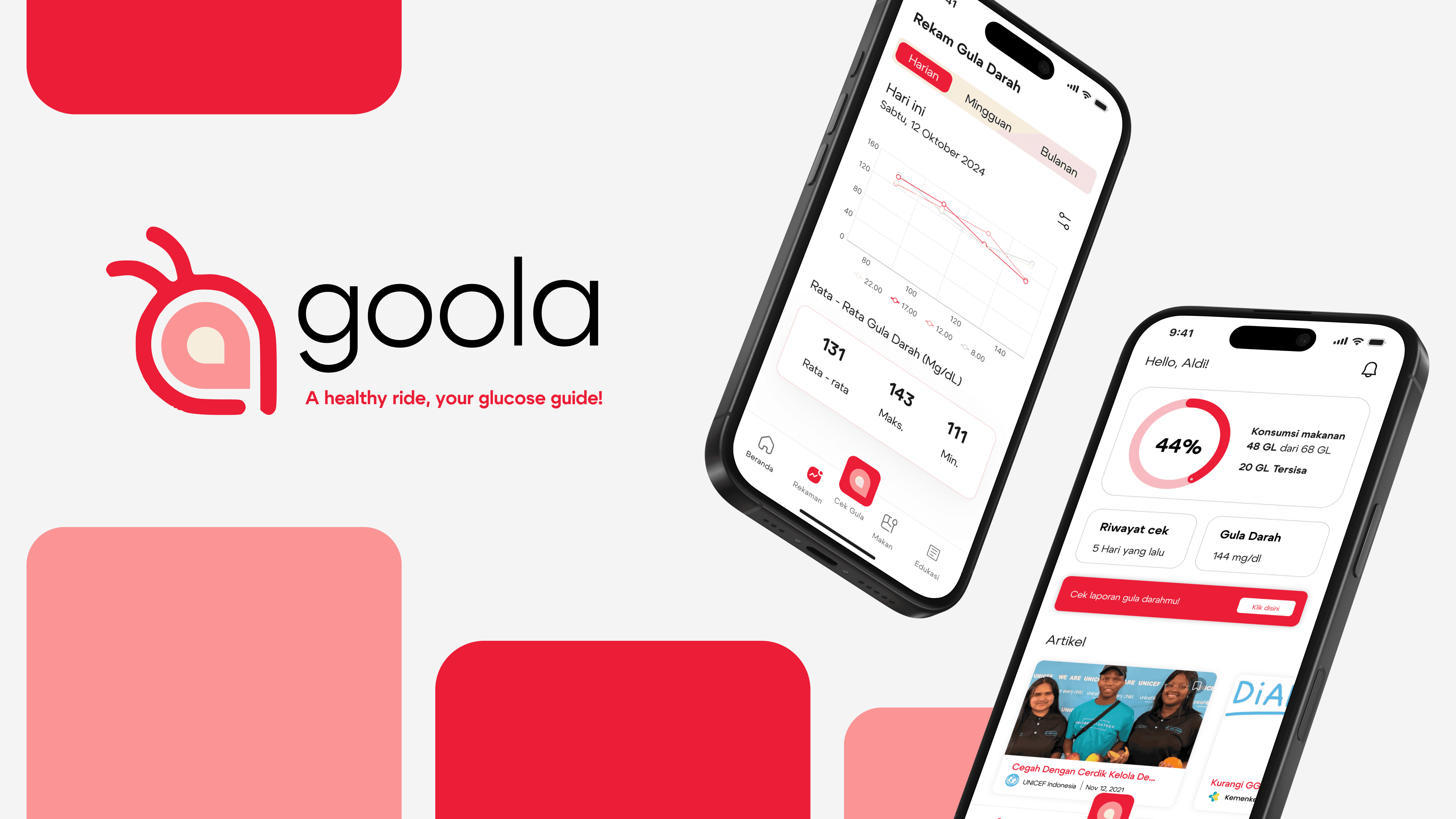
Goola App
― A diabetes self-management product case built from research and business analysis
People who manage diabetes must connect glucose readings, food choices, and health guidance across repeated daily decisions. The Goola case examined how one mobile product could support that routine without presenting itself as a clinical diagnosis tool.
| Field | Record |
|---|---|
| Role | Product manager and UI/UX designer |
| Period | 2024 |
| Context | Ruangguru x MSIB product management case |
| Output | Product analysis, prototype, pricing direction, KPI framework, and roadmap |
Problem
The case focused on three linked problems: users miss glucose checks, struggle to connect nutrition guidance with daily meals, and receive little support between health visits. A feature list could cover these subjects while leaving users with the same fragmented routine.
I framed the product around a repeated loop: record a reading, understand the context, choose an action, and return for the next check.
Role and scope
I worked across problem framing, competitive research, market sizing, pricing, KPI design, prioritization, and interface design. I presented the recommendation and prototype as a product case.
The work remained a concept. I did not run a clinical study or launch Goola with patients, so I make no health-outcome claim.
Process and decisions
I compared products that covered glucose logs, education, and meal planning. The comparison showed that feature breadth alone would not create a coherent routine. I grouped the experience around the next decision a user needs to make.
I used TAM and SOM work to define the market argument, then connected pricing to the proposed value. The KPI framework covered activation, repeated logging, education use, and retention. The roadmap placed the core self-management loop before broader feature expansion.
Product package
The project produced a linked set of artifacts instead of a screen collection:
| Decision area | Artifact |
|---|---|
| User problem | Problem statement and journey |
| Market | Competitor review and TAM/SOM model |
| Business | Pricing direction and KPI framework |
| Product | Prioritized roadmap and interactive prototype |
I connected user needs, business constraints, and interface decisions in one product package. The team did not release the concept, so I do not report adoption, conversion, or retention.
Limits
I worked without a clinical partner, longitudinal study, or production usage. Future work needs interviews with patients and health workers, task-based usability tests, and review by a qualified medical professional before the product handles health guidance.